Yesterday, facing a yard that needed pruning, a pile of paperwork that needed sorting, a stack of music that needed learning and a house that needed cleaning, I found myself thinking about motivation.
I think about motivation a lot. And not just when staring down a list of unpleasant chores. I think about motivation because, well, Andrew.
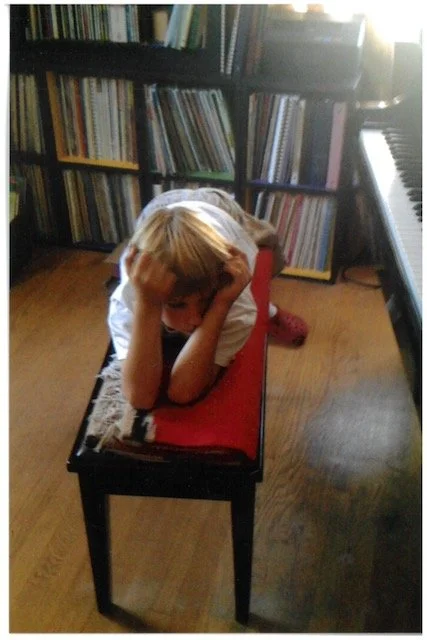
Andrew is seven. Andrew is seven years old and wiggly. Andrew is the third child in a family very committed to music education. There was, of course, no question that Andrew would take piano lessons just like his older brother and sister. At least, no one questioned this except perhaps Andrew.
Did I mention that Andrew wiggles? Andrew is also a star gymnast, frequently winning gold medals in competitions. Andrew prefers to tap out rhythms not with his hands on the piano lid while still sitting still on the bench, but while walking on his hands across my living room floor. This activity focuses his attention. Anything else—learning to read notes, trying to make his clumsy fingers cooperate, listening to his teacher—is boring.
And so, Andrew wiggles. And wiggles. And wiggles.
I have long understood that strategizing about motivation is the first job of any thoughtful music teacher. Unless a student is motivated to attend to our instruction, and then to learn and practice on their own, all our wisdom and smart pedagogy is useless. See above: Andrew. And for that matter: Lucy, Jake, Clare, Isabel, Sarah, Mike, Daniel and Corrine, and every other person that has ever walked into the studio.
There must be as many different factors that fuel the motivation to work as there are students. Some students are highly motivated by particular pieces or styles. They will practice enthusiastically if they like what they are playing, but otherwise, these students are quite likely to ignore my assignments. They conveniently lose collections they don’t like. They forget to read my brightly colored instructions about scales or sight-reading. They often have huge gaps in their skills or repertoire: chord progressions, yes; theory, no. Twentieth-century repertoire, absolutely; Baroque literature, never. Convincing repertoire-driven students to practice what they don’t like is often a losing battle. Finding music that motivates can be equally time-consuming. Understanding the motivational factors at work isn’t particularly complicated: interest, not necessarily self-discipline, is the driving factor here. But that doesn’t mean it isn’t still a game that must be played, rules must be negotiated and understood, allowances made. Many times it’s my pedagogical ideal of training a well-rounded musician that is compromised in the process.
Other students practice thoroughly, but intermittently. They have week after week of strong preparation and then fall off the wagon and seem unable, without great effort and nagging on my part, to reestablish their previously stellar practice routines. They seem to lack the inner resources when the going gets tough, when the music gets more difficult, or when life throws stresses or obstacles their way. Their motivation is fleeting, inconsistent. Here today, gone tomorrow.
Yet still other students are predictable in their unwillingness to tackle certain things: new repertoire, sight-reading, technique work. While they will obediently practice much of their assignments, they can be stubborn about what they refuse to do. Sometimes their reluctance is simply a distaste for a certain task: They don’t like scales or sonatinas. Other times it might be due to a lack of confidence in a certain area, a willingness to accept the consequences of non-compliance rather than face possible failure. In these cases, the game is all too familiar: either they train the teacher to stop requiring their least favorite tasks or they are forced into submission. Either way, on some level, everyone loses.
Then there are students who are driven by their need for accomplishment. They practice to achieve new skills, more difficult repertoire, faster scales. They are forever racing after goals in the distance, often impatient by the tedious work to get there, and therefore sometimes sloppy in their work, so motivated are they by the act of checking off one more thing on their musical to-do list.
Finally, there are those students that are primarily motivated by the desire to please. They may be interested in pleasing their teacher, their parents, their older musical sibling, or a favorite uncle. They practice all their assignments diligently and thoroughly. They cooperate in lessons and don’t question my opinions or suggestions. They may be talented musicians or not, they may be happy students or indifferent ones, they may possess good musical instincts or poor ones, but ultimately it is the desire to please someone that over and over again gets them to the piano bench in the first place.
But the biggest challenge is that no matter how neatly we can label students by their tendencies and patterns, the construct of motivation itself is not so easily boxed and contained. What motivates us is not constant or predictable; instead, it ebbs and flows from day to day, from task to task, even from hour to hour within the same task. Each one of us has the potential to fall under any given motivational category depending upon the practice in front of us. Sometimes interest drives our work; sometimes the desire to make someone else happy propels us into action. There are often certain chores we will do anything to avoid, but then at other times we are motivated to work carefully at even the most unpleasant tasks. The fact of the matter is that we human beings are messy, complicated creatures. We find a momentum and coast effortlessly for a while and then without explanation or reason, we suddenly hit a wall. And while motivational purists don’t often like to admit this, from time to time we may need a carrot to lure us over that wall, to prompt us into once again attending to our work.
At one time or another, I have been every one of these students.
Today, for example. I know what I should be doing: I should get to the piano and learn that piano trio I’m playing on a concert in a few months. I should read through that pile of sheet music and pick out some potential new repertoire for students. I should repot that cactus that I carried down to the basement last fall when I was bringing in the outside plants from the garden. I should make a plan for the flowerbed along the driveway, buy lavender and yarrow, and then put them in the ground. I should send that email, make that phone call, throw out that pile of New Yorkers that stare at me accusingly, knowing I will never catch up on last months’ news.
Although today’s lapse in motivation is mostly likely fleeting, I have experienced slumps that lasted weeks, even months. I cannot blame these times on a lack of interest; I haven’t lost my desire to be a musician or a teacher or a well-functioning adult. I just don’t want to work. This, says those who spend their lives studying motivation, is an issue of self-regulation, the idea that we know how to work, how to motivate ourselves to get a task done, how to use learning strategies appropriately, and how to evaluate our progress and adjust our efforts accordingly. In a nutshell, this is practicing. Or, as in my case today, a lack thereof.
Motivational theorists are quick to remind me that I don’t just need a goal, I need a system. Or as Kevin Kelly wrote in Excellent Advice for Living: “If your goal does not have a schedule, it is a dream.” Exactly. I have so many dreams, as it turns out. Fortunately, there are plenty of antidotes to this lapse in self-discipline, clever tricks to prompt me into attending to my work, to help me set up a foolproof plan of accountability, and to coax my behavior back into compliance.
Some days all it takes to kick me into action is the old kitchen timer. The concept of the timer is so simple it’s tempting to want to underestimate how effective it can be. The timer trick works on the theory that often it is the anticipation of the task before us that is the problem and not the actual work involved. I understand this far too well, knowing that it isn’t practicing Schubert that is the sticking point, for once I begin I will inevitably find a groove to my work. It is the reluctance to get off the couch and begin that is holding me back from doing my job.
Which is why a timer can be so helpful at jumpstarting the momentum needed to get going because we are less likely to resist something if we believe we don’t have to do it for very long. “I’ll just practice for five minutes,” I think to myself, and then before I know it half an hour has gone by. It’s a cheap trick to be sure, but it works. I clean the house in ten-minute spurts. I organize teaching material in fifteen-minute bursts of energy fueled by the reassuring tick of a timer by my side. I get myself to the meditation cushion for twenty minutes a day, knowing that the chime that rings every five minutes will help to nudge me along.
As any seasoned procrastinator knows, there must be something primal about working against the clock, spurring us into action and heightened attention. It’s like interval training at the gym: for the next thirty seconds we are going to give it all we’ve got, knowing there is a limit to this ridiculous exertion. Timers give us a boundary we can understand and relate to, holding the space for our practice and containing, even briefly, our resistance. Pulling the three-minute timer off the bookshelf next to the piano signals to my students that the race has begun. Students rarely balk at the challenge. After all, three minutes is nothing, right? Anyone can focus that long. But we soon learn that three minutes is, in fact, significant. We discover that a lot can be fixed in three-minute chunks. Indeed, the timer has a way of quickly revealing our tendencies to rush through our work and not stay with a problem long enough to fix anything. If we can work out a thorny passage in a mere three minutes, what does this say about our practicing in general? A timer not only provides motivation to start working in the first place, it’s a handy tool of accountability as well.
Those folks who study what makes us efficient and productive are not only well-versed in helpful tools and gadgets that prod us along, but they understand that that overwhelming projects are just a series of tasks that can be broken down into manageable steps, one following logically on another. Identifying the first step—the one that is so small it doesn’t even warrant resisting—is not only the way around a perfectionists’ rigid mentality, it is also, ironically, the first step of setting up any good system of self-regulation as well. Mentally, I scroll through my own list of one-off chores and begin to strategize: I can start by carrying the plant up out of the basement, putting the stack of music on the back of the piano, spending five minutes clearing the flower bed of leaves and debris. Suddenly, some of my resistance melts, or is perhaps too embarrassed to hang around any longer. Who could fight carrying a plant up from the basement?
Well, it turns out, I could. Which is when pure unadulterated bribery is called for.
Thankfully, I teach children. I teach children who teach me everything I need to know if only I would pay attention. I am reminded of this at least ten times every day.
Take Andrew, for example.
One day, frustrated and grasping desperately at anything that might capture his interest, or at least get us through that afternoon’s lesson, I got an idea. “Hey Andrew,” I said, “do you like to watch the Olympics?”
He brightened immediately. “What if,” I continued, “I was like an Olympic judge and we rated each of your assignments? If you get a top score, we’ll put a sticker on your practice notebook.” “How many stickers could I get?” he asked, very interested. “A lot,” I said, making the rules of the game up on the spot.
For the rest of the lesson, Andrew was a model student. He carefully demonstrated the scales and pieces he had practiced and together we rated each little piece or technical exercise. He was, to my astonishment, a tougher judge than I was. “I don’t think that gets a sticker today,” he said after a poor performance of one piece and shook his head.
Weeks went by. Every lesson became an Olympic sport, stickers the prize. “If we get everything done, could we do extra things for more stickers?” he’d ask. “Sure,” I’d respond, thrilled that Andrew and I were finally on the same page. Some days, he’d come into his lesson and announce, “This is probably not going to be a good sticker day.” “Why not?” I’d ask. “I didn’t practice so good,” he’d admit. He became very accurate at assessing his work. He could tell me before we began what was likely to get a sticker or not, demonstrating quite advanced meta-cognitive skills. “Amy,” he said one day, “I think that stickers are really working for me.”
Could it be that Andrew was motivated to work hard and to sit still by the promise of a mere sticker? A sticker? Why would a seven-year-old boy care about a sticker?
The reality is, he didn’t. Andrew was not motivated by the actual sticker; it was merely symbolic. What was feeding his enthusiasm and good behavior was the tangible and immediate feedback for a job well done. There is something about the immediacy of a sticker that is remarkably effective.
Ater months of Olympic piano lessons, where the very texture of our work together had changed and evolved into something new, I realized that Andrew was no longer talking about the stickers. He had, it seemed, outgrown them. “Hey Andrew,” I said, “what about the stickers?” He shrugged. “I don’t care anymore.”
He had, at least for the time being, found the play in his practice. I suspected that this high level of motivation would not last forever, and that the wiggles would return again in some form or another requiring another burst of stickers to bolster up our work. But it’s a delicate balance to find: In order to play the game of effective self-regulation well, we should not introduce bribes or rewards until we need them. Then the minute we become intrinsically motivated to do something, the effectiveness or need for the reward goes away, because the activity itself serves as the reward.
Make no mistake about it: motivation is complicated. Just ask anyone who struggles to stay on a diet, keep their Lenten intentions, make a budget. Working with motivation isn’t just an educational psychology concept, although it certainly is that. It’s stickers and kitchen timers, bribes and rewards. It’s a spiritual practice, a sweet place of self-discovery, an area of endless curiosity. It’s galaxy of gold stars just waiting for our attention.
Just ask Andrew.