This morning I found myself thinking about Sisyphus.
Sisyphus, you recall, is the mythological character who is fated to spend eternity rolling a boulder up a hill. Poor Sisyphus came to mind this morning as I was moving rocks around in my garden.
Admittedly, my garden is not on an incline of any kind. But in my quest to create a desert garden oasis, I have realized that rocks are my best friend. Rocks provide structure and weed control. Rocks give the ground texture and interest. And rocks can be moved.
I have a friend who is on a quest to rid her garden of rocks. She spends entire Saturdays digging rocks out of flowerbeds. She wants fewer rocks; I want more rocks. This only reinforces my deeply held belief that there is enough of everything in this world. We just have a distribution problem.
And so it came to pass that I spent my morning hauling rocks, pondering Sisyphus.
It wasn’t a bad way to spend a Monday morning in mid-April. The weather was slightly cloudy and cool. I had a rare day off from teaching, which gave my day some welcomed flexibility. After multiple trips to nurseries and garden stores during my spring break a few weeks ago, I had just that weekend declared to myself that this year’s planting was done. Done!
“Done,” it turns out, might be my favorite four-letter word. But “done” is not a word I use often. Nothing, in a life of practice, is ever done. Most of the time, I can live quite happily in my self-created playlist of action verbs: teaching, writing, reading, gardening, listening, practicing and rehearsing. But every once in a while the idea of “done” is pretty sweet.
The rock project, however? So not done.
The 2026 April Playlist.
Teaching: In the studio, we are a month away from the annual spring recital, which means, it is all about musical hygiene. Actually, practicing might always be about good honest cleanup: taking gnarling sections apart one hand at a time, inserting fermatas into passages with wicked jumps and angular lines, experimenting with different tempi, from super slo-mo to right on the edge of our comfort zone, dissecting our memory spots for hooks of harmony or key structure. It’s all hygiene.
Mostly, the kids are all in. “How many weeks till the recital?” they ask. “Six weeks.” “Five weeks.” “Four weeks.” I tell them, week after week. Even the littlest ones nod at this serious reckoning of the passage of time. One high schooler playing a big piece by Ravel said to me last week, “Amy, I doubt if I will ever feel completely ready.” I nod. In the end, that is the beautiful point of all of this. We can exist inside great music and practice and grow and explore forever. We are never done.
Gardening: Last Friday I received a text from a friend. “You probably already know about this, but…” and MaryBeth forwarded a link to the Cactus and Succulent Society Annual Show at the Albuquerque Garden Center taking place the next morning. Doors opened at 10am.
Immediately, I was intrigued. And so, Saturday morning after reading and drinking coffee, I decided that this event was worth checking out. If I am going to turn my garden into a desert cottage garden, it would need more cacti. And succulents.
As I walked into the garden center, I glanced at my phone before stashing it in my bag. It was 10:01am. “Well,” I thought, “I’m kinda nerdy getting here right when it opens,” and proceeded to walk into a room that was jammed wall-to-wall with folks carrying cardboard flats full of prickly things. My jaw dropped. I had never seen so many people stuffed into a room of plants. Let alone plants that one could impale oneself upon and cause serious injury.
A few minutes later I ran into my friends MaryBeth and her partner Jim. “Who knew?” I said. “Where did all these people come from anyway?” “The line was out the door at 9:30,” Jim replied. “Give it an hour and everything will be sold.”
Wow. Also: Wow.
I quickly learned that as soon as I would pick up an unusual-looking plant, someone would appear at my shoulder and begin giving me helpful instructions. “If you plant it in a big pot and put it outside it will grow huge. But if you want to keep it small, plant it in a small pot and keep it inside.” Every other one of these hundreds of people was a volunteer for the Cactus and Succulent Society and they took their job of educating the public seriously. I loved this. I want to go through my days having a teacher whisper wise directions in my ear all the time.
Or at the very least, tell me how to not kill my fancy new aloe.
Writing (from Lost Time April 2023):
Some people fear heights. Some are afraid of water. I have a strong aversion to the idea of having empty time and space and later not being able to account for it. It’s not that I don’t putter away time. I can happily spend the afternoon napping on the couch. I can linger over the Sunday newspaper and a cup of coffee without regret. I can while away an evening with friends and a bottle of wine. I can sit in the backyard and lose myself watching a hummingbird flit from flower to flower. No doubt about it, I can fritter away time with the best of them. What I can’t stomach is not knowing afterwards what I did with my hours. Non-productive time is one thing; time unaccounted for is quite another.
The creativity guru Julia Cameron teaches something she calls Ta-dah! lists. As opposed to To-Do lists, which reminds us of the tasks of the day, this is a list that takes note of what one has actually done in a given period of time. Past tense versus future. Instead of Prune the roses, vacuum, file taxes, it might say Read “Moby Dick”, baked cookies, listened to Mahler’s 4th Symphony, weeded the tomatoes, scrubbed the toilet…Ta-dah! lists are a way of acknowledging how we have spent our time, an especially good antidote to those days (weeks!) when we wonder where the hours have gone and what we might have to show for them. As Cameron says, “Facts are the opposite of drama…Often our days are far busier and more productive than we realize.” We fill our time, no doubt about it, the question is whether or not we know how we fill it.
We often think about our lives and the ordinariness of our days in generalities, but the truth is we live in specifics, in details, if only we are paying attention. Ta-dah! lists remind us of this. We didn’t just “hang out” or “do nothing” all weekend. We made scrambled eggs and looked at Facebook or took a walk and talked to our sister. We did a load of laundry and listened to NPR or we practiced the piano for an hour and then baked a cake.
…Whatever our relationship might be with time, to-do lists or Ta-dah! lists, life is rarely all or nothing. Most days we live inside the messy “some.” It’s a good reminder that I function better in a world grounded in facts, not spun out in some dramatized version of my imagination. Right now, there are twenty-one brilliant red flowers on my amaryllis. There are seven daffodils in the courtyard. My orchid has three new leaves. I swam 37 minutes this morning and put in three hours on the piano yesterday. Wednesday afternoon I had a root canal. Friday morning I had breakfast with a dear friend.
It’s something.
Reading:
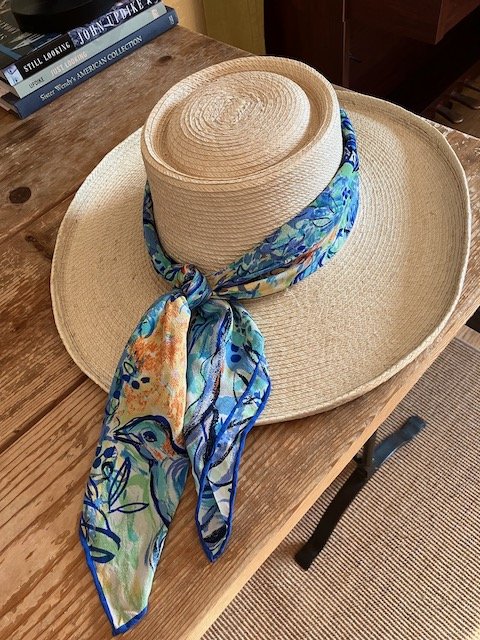
One day during my spring break a few weeks ago, I took the train to Santa Fe. I wanted a day of meandering through boutiques and art galleries. I made plans to meet up with a friend in the afternoon for a walk and dinner. I had a new hat and brought a cute basket to carry my treasures.
By the end of the day of shopping in thrift stores and bookshops, I had two more hats. And a second straw bag. And I was carrying my weight in books. At the time, it made perfect sense.
The subject of hats reminds me of a brilliant trilogy of children’s books by Jon Klassen: I Want My Hat Back, This is Not My Hat, & We Found a Hat. The first book is about a bear who loses a hat:
“Have you seen my hat?”
“No. I have not seen any hats around here.”
“OK. Thank you anyway.”
“Have you seen my hat?”
“What is a hat?”
“Thank you anyway.”
The second book is about a fish who steals a hat from a shark: “This hat is not mine. I just stole it…I know it’s wrong to steal a hat. I know it does not belong to me. But I am going to keep it. It was too small for him anyway. It fits me just right.”
The third volume of the series is about two turtles wandering through the desert: “What are you dreaming about?” “I will tell you what I am dreaming about. I am dreaming that I have a hat. It looks very good one me. You are also there. You also have a hat. It looks very good on you too.”
“We both have hats?”
Anyway. There I am wandering around Santa Fe with hats to share with two friends and in a used bookstore I find the book In Praise of Slowness by Carl Honoré. The title grabbed my attention immediately. After all, I was on spring break. I was puttering around Santa Fe. I was all about the slowness, savoring the moment, seizing the day (with my three hats!). Have you seen my hat?
Written in 2004, this book offers nothing particularly new on the subject of rejecting the ridiculous busyness of modern life, but still it was worth reading. My day in Santa Fe coincided with Good Friday, the end of Lent. It was a year ago during Lent that I took up the noble intention to try to break my horrible habit of multi-tasking during piano lessons (talking while students are playing, writing while students are playing, talking while I am writing…the variations here are endless. And not that amusing.).
It didn’t take me too long to figure out that I multi-task not just in lessons, but all the time, in stupid, insidious ways (See last month’s self-inflicted plumbing emergency).
I multi-task because I don’t want to waste time. I multi-task because I’m impatient. I multi-task because I am bored.
The Lenten intention to look at my multi-tasking problem while teaching morphed into a wider commitment to try to learn to Do One Thing across the patterns of my life at large. This intention is so humbling and powerful that I have become convinced that I will never need to adopt another resolution ever. Forget Lenten acts of sacrifice or good will or New Year’s resolutions of change and discipline. I’m all set. This is the forever guru, the lifetime spiritual practice. Which now that I think about it might be the ultimate meta version of Do One Thing.
Here's what psychologists and cognitive scientists have been telling us for years: No one can really multi-task. When we think we are multi-tasking, either we are choosing to do something other than the task at hand in that moment or we are switching rapidly between multiple tasks. For example, when I am writing while students are playing, I’m writing. Not listening. I might switch back quickly to listening after I have jotted down my thought, but trust me, I miss stuff. Lots of stuff.
But if I am paying attention, I certainly won’t need little Post-it note reminders in my teaching notebook telling me to remember to look out for Julie’s bad fingering in her B-flat scale because I will notice that for sure. I don’t need to make a note to check Jake’s pedaling because if I’m not otherwise distracted, I’ll won’t miss his tendency to pedal not just with the toes of his right foot, but with his whole entire leg. I’ll catch Josie’s habitually bad posture and Jonah’s funny angled left wrist. I will hear that questionable note in that tricky chromatic passage. I’ll home in on the strange phrasing in the development. I’ll see the unnecessarily awkward left-hand movements in the accompaniment section. It’s stupidly simple. And yet such difficult behavior to practice.
It is difficult because our modern living applauds efficiency and productivity and encourages distractions. We love our Ta-Dah! Lists, the evidence of our worth and accomplishments. But imagine going to a medical appointment and having the doctor spend the entire time—not scribbling notes or making charts on their computer—but paying attention to everything we brought that day: the concerns we might have, the unspoken fears and hidden subjects, the tone of our voices, the way we sit and breathe and avoid eye contact, the funny limp we didn’t even know we had. Imagine if teachers had enough time and space to explore questions and curiosities and didn’t superimpose a learning agenda on every student. Imagine if our friends felt listened to when we met for a drink, or our children didn’t compete with our devices for our attention. Imagine just doing the one thing that the moment is calling for and nothing else. It could change the world.
Doing One Thing isn’t always slow, I have discovered, nor does it mean never juggling tasks in rapid succession, but it is a tangible way of attending to the work, the person, the world in front of me with deep and profound integrity. Reading In Praise of Slowness the last month has been gentle and welcomed reinforcement to a practice that never is really done, a quiet voice whispering encouragement in my ear. I need it.
So as another month of a difficult year rolls past, we move our rocks. We wear our many hats. We do one thing. And then the next.