The May Playlist
The verb of the month is “administrating.”
Or as my friend Anne calls it: “deep desk.”
All of this is just a way of saying that the month of May corresponds with the end of the semester and always includes a lot of time at my desk: reconciling last tuition payments and attendance records, sorting through piles of music needing to be shelved, putting together a summer lesson schedule, teasing out the order of students for the recital program, and mountains of communication—texts/emails/phone calls—about all of the above. It’s what I call my “non-billable hours.” It is life-sucking, soul-draining, spirit-crushing. And it must be done.
And so, the May playlist of verbs starts and ends with: “Administrating.”
But the month of May is a celebratory season as well. The garden is peaking: there are ten thousand roses in bloom, purple and pink larkspur are sprouting up everywhere, the hollyhocks dance in the sun. The weather is bright and warm. The hummingbirds are back, as are the relentless New Mexico spring winds. After a non-existent winter with no snow, we are bone dry. The threat of a dangerous fire season has begun.
And also, you know, Cinco de Mayo.
This refers to my all-time favorite student anecdote. Years ago, I was teaching Max, an overly eager red-headed kid. For the spring studio recital he was playing some elementary piece entitled “Song of Seville” or “Spanish Dance” or something. One day a few weeks before the studio recital he turned to me, “Miss Amy!” he said with great enthusiasm. “This is perfect for the recital.”
“Yeah?” I said, not sure where this was going.
“It’s perfect, because you know, Cinco de Mayo.”
“The recital is May 12th,” I told him. “Do you know what Cinco de Mayo means?”
“Cinco de Mayo,” he repeated slowly. “The fifth of May.”
“Yep.”
“WAIT A MINUTE! Is Cinco de Mayo on the fifth of May every year?”
Every year, every fifth of May, I remember that story, and smile.
The 2026 May Playlist:
Teaching: This is also the season for last lessons, last studio classes, last run-throughs before the recital, last practice boxes of the semester, last 8am lessons of the school calendar. In a year where time seemed muddled and upside down, all of these last things make my head spin.
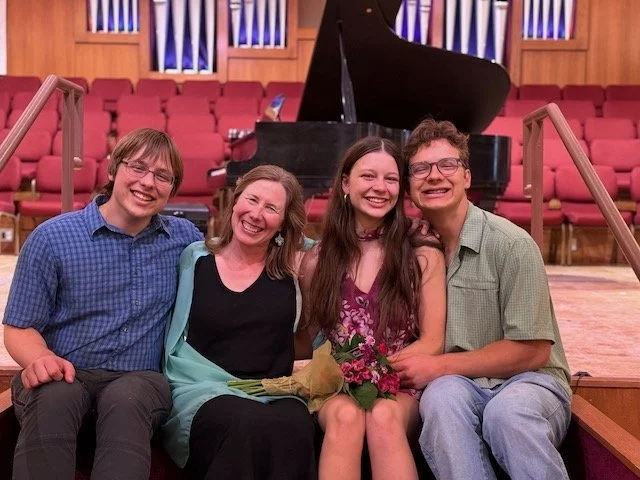
Last Tuesday was my final lesson with Grace, a senior and the fourth (and last!) child of a beloved piano family. Her oldest brother Jeremy walked into my studio—a precocious tow-headed 6-year-old kid—almost 21 years ago, a fact that makes me want to pour a drink.
While Jeremy had his lessons, his dad walked baby Henry around in circles through the house. Caroline joined the studio when she turned six, and then Henry, and somewhere in there Grace was born. “You have been in my entire life!” Grace said to me on Tuesday. It’s true.
Not only have I had a sizable piece of these kids’ childhoods, but they have held a huge chunk of my career. 21 years. Even if another large family of music-enthusiasts entered my studio today, it’s hard to imagine that I would last the distance.
But what a sweet chapter it has been. I look at those four kids—all of whom I love and with whom I treasure very individual relationships—and think, I am a different teacher now than I was 21 years ago. I have different standards and priorities; I’m both softer and tougher depending on the subject at hand; I have a longer view than I did two decades ago when every bump in the road seemed like an insurmountable hurdle.
Grace and I had a precious last lesson, the “break-up lesson” the kids call it. “How does it feel to walk into your last piano lesson?” I asked her. “It’s sad,” she said. “This is way harder than leaving school.”
It’s the end of an era for both of us, I reminded her. She is well aware—and very proud!—of her family’s place in my studio history. But if her older siblings are any indication, the pattern of coming by for tea and long conversations is already set. In fact, I saw Henry, Caroline and Jeremy each for their own teas last week, as they were all home to celebrate their sister’s piano recital and graduation this weekend.
Grace is a particularly poignant goodbye, but every year when I think about the older kids exiting the studio, I wail and scream and gnash my teeth. “Don’t leave us!” I think. “We need your leadership and all your skills. We can’t do this without you.” I look in dismay at the Little Ones: there are so many, and they need to be taught everything, and they are so wiggly.
And then I remember: The Little Ones will step up. They always do. They will grow—quite literally!—taller than me, they will learn to be beautiful musicians and wonderful creative human beings, and we will be OK. It’s a ten thousand stars miracle and it happens every time.
Writing (from A Sacred Threshold April 2021):
Because what I know, and the kids do too if you question them hard enough, is that the recital was never the point of our work together anyway. The recital is merely the punctuation on weeks and months of careful practice and preparation. The work to get to the recital is where the real growth takes place: the moment we realize we don’t really know the B section of our piece; the stumbles that humble us when we play for our peers in performance class; the corner we turn when we go from merely playing at the music to owning it. One spring during a pre-recital performance class, I witnessed this exchange: “I know why we have performance class,” one kid announced to his class of eight-and-nine-year-old pianists. “Because in performance class we all mess up sometimes and we know that no one is going to laugh at us or make fun of us.” Another kid followed up this comment with: “I know why performance classes are required.” (The kids are, and rightly so, very impressed with the idea of required classes.) “Because we play better at the recital when we have to play in performance classes. Like, the recital isn’t the first time we have ever played our piece for someone.” Yet another Little One had this advice for his young classmates: “When you have a memory problem—I know because I have lots of them!—you should just think like Nemo. Instead of ‘Keep swimming’ you should think ‘Keep playing.’” Ah, these kids are so smart.
Gardening: Last weekend after the final Quintessence concert, Matt and I held our annual end-of-year garden party. “We will provide a semi-clean house and a beautiful garden,” Matt wrote to the choir in the party invitation. “I have been working very hard at it.”
Huh.
To his credit, on his last trip to Costco Matt sent me a photo of “Chariots pour plantes” and asked, “Want any of these?” I did. Six to be exact.
A “plant chariot” is basically a small, flat cart with wheels. I think that when Matt spotted this item at Costco he was not so much thinking of me, as thinking of himself and all the times his help is requested to move huge plants in giant pots. But regardless, we both win here.
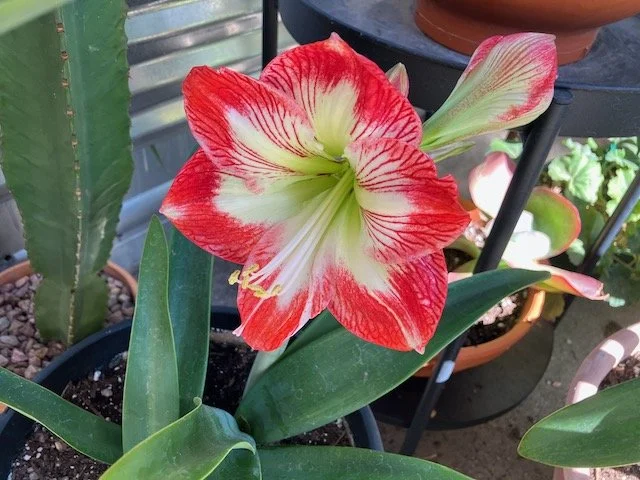
The highlight of this year’s garden is what I call the “Amaryllis Farm.” Years ago, I inherited a split from my mother’s prized amaryllis. Then some time ago after she and Dad moved into a retirement center, I inherited two more ginormous pots of amaryllis bulbs. This, I will tell you, is a lot of pressure.
Because Momma is watching I cannot kill her precious amaryllis. But nor can I shoehorn three huge pots of amaryllis into my small house. The inheritance stays outside, subject to cold nighttime temps and blazing sunlight. Tough love, I say.
But victory is mine. This year, we are sporting some 11 flower stalks totaling 45+ blooms. There are signs that the bulbs are splitting and shooting up new leaves, which means Momma has nothing to worry about. The future of the Amaryllis Farm is safe and secure.
Rehearsing/Practicing/Listening: This month is all about the Arensky Piano Trio, a piece that is the cornerstone of the Movable Sol season finale next weekend. When my colleagues Joel and Ruxandra suggested the Arensky trio, my first thought was, “Arensky who?”
Anton Arensky was a Russian composer writing around the turn of the 20th century in the Romantic tradition and spirit of Tchaikovsky. The D-minor Piano Trio is tightly constructed and brilliant in its resourceful use of only a few themes, reworked and reconfigured throughout the four movements. I want the third movement played at my funeral it is so breathtakingly beautiful.
The work is also, I have repeatedly told my colleagues, a bit of a tour de force for the pianist. I may be officially on semester break this last week, but suffice to say, I have been practicing. A lot.
And so as we wind up another school year, another MovSol and Quintessence season, another spring in New Mexico, we count our small victories, our precious moments, our countless blessings: the dozens of beautiful amaryllis flowers, the hours of un-billable administrative work completed, the families that come into the studio and stay for decades, the music that enters our lives and our practice hours and rearranges the molecules of our souls, the goodbyes that tear open our hearts, and the Little Ones that show us the way into the future. Mark the time, said poet Max Coots:
Respond with thought or prayer or smile or grief.
Let nothing living slip between the fingers of your mind,
for all of these are holy things we will not, cannot, find again.
Mark the time,I tell myself, viscerally aware of this precious liminal space between chapters of life and work, seasons and semesters. As she was leaving the recital last Saturday, seven-year-old Annie stopped to give me a hug. “Miss Amy!” she said. “You are an amazing teacher. I am so proud of you.”
They step up, those Little Ones. Every single time.