The October Playlist
Last week a kid came into the studio and announced:
"I was thinking that in the Ten Thousand Stars Studio there are five significant dates. The first lesson. The first recital. The last lesson. The last recital. And the first day you drive yourself to a piano lesson!"
Zach has been in the studio for a dozen years. He is a high school senior, already we are counting the number of lessons left in our time together and the other significant dates ahead of us. The kids grow up so fast.
Recently, my watch stopped, which muddled my sense of significant time completely. This is the old-fashioned watch (AKA “single-use device”) that I bought some 20+ years ago. It probably needs a new battery, but ironically, I haven’t had time to figure that out. It reminds me a song Quintessence sang in last weekend’s concert, “In the Middle” by Dale Trumbore. The text by Barbara Crooker reads,
In the middle
of a life that’s as complicated as everyone else’s,
struggling for balance, juggling time.
The mantle clock that was my grandfather’s
has stopped at 9:20; we haven’t had time
to get it repaired…
Likewise, I find myself stumbling along without an instrument to track my minutes and hours, which is both wonderful and weird. I love the idea of being liberated from the straitjacket of time’s relentless forward march, but my entire working life requires close attention to the clock. Five hours of back-to-back lessons demands that I know what time it is with some degree of accuracy.
The obvious solution, of course? My phone.
Normally, I try never to look at my computer or my phone during lessons, because it’s too easy to get sucked down a rabbit hole of texts and missed calls. After all, students are paying for my complete attention. The distraction of seeing a missed call from my sister does nothing to improve my concentration on the fussy articulation details in a Mozart sonata. Using my phone as a time-keeping device is not a long-term answer, but until I can get my battery replaced it will have to do for now.
But it strikes me that while getting lost in time might be a beautiful thing occasionally, there is also something to be said for a strong internal clock, the ability to measure the passage of time intuitively. Finding flow in our work doesn’t mean we can’t also stay grounded in the passing of the seconds, minutes, hours. And here’ the thing: I have taught a lot of 45-minute lessons in my career. I have sat a lot of 25-minute sits at the Zen center. I have raised a lot of children in the studio. I know what these lengths of time feel like viscerally, just like I know if I’ve dropped a beat in a 4/4 measure. Musicians are used to counting, marking time with our bodies, our inner metronomes attending to time signatures and tempi with grace and ease.
Turns out, with a little creativity, there are ten thousand ways to keep time, count our minutes, track our place in the world as we take another spin around the sun. The bells at Catholic church a few blocks away ring every quarter hour. The tourist trolley goes by our house every two hours at five minutes past the hour. A tiny cup holding two shots of espresso is worth 20 minutes of reading in the morning on the couch. It takes 13 minutes to bike to the Zen Center, 29 minutes to walk; 8 minutes to drive to my yoga studio and 4 minutes to check the fingering in Teddy’s sonatina. Charlie’s lesson will end when Clara walks in whether or not I have been obsessive about our productivity every second. These days the morning sunshine coming through the front window blinds me while I’m sitting on the piano bench until approximately 10:37am. Or tomorrow maybe 10:36am. In the evenings, I must turn on my desk lamps during my 5pm lesson so I can see to write practice notes. After my lessons, there is just enough time to stroll around the block and water the pots of geraniums in the courtyard while Matt finishes up dinner. Just a few weeks ago, I saw the biggest harvest moon coming over the mountains as I took my post-teaching walk, but this morning at dawn there was only a sliver of a moon in the eastern sky. The sand in the hourglass falls silently. The kids grow up so fast. One day we wake up and discover that we are no longer the “new, young, interesting musicians” in town; instead, we are mentoring the “new, young, interesting musicians.” Blink, and the hours, days, weeks, years disappear.
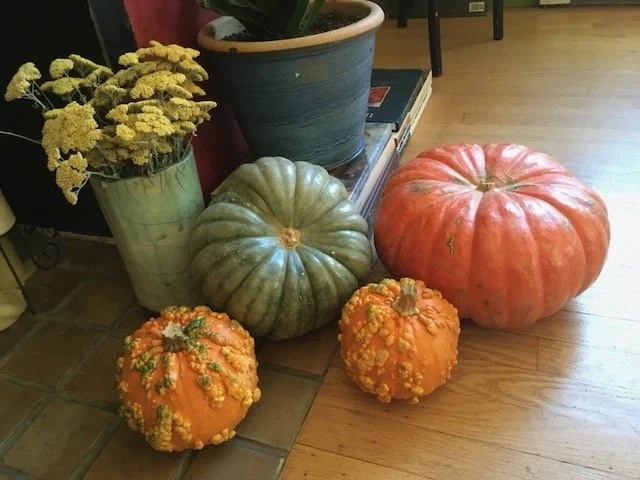
And so, here we find ourselves: October. Fall. The days shorten, the leaves begin changing. Soup has reappeared on our dinner table; last week I wore socks for the first time in months. The rains of the last few weeks have stopped, and the New Mexico sky is the most brilliant blue outlining the sharp adobe corners of our square houses and buildings. Hot-air balloons drift across the morning dawn; the hummingbirds are gone, migrated to their winter homes. The smell of roasted green chile is everywhere. Temperatures linger in the 70s every day, a beautiful something I will never take for granted after living through the last dreadfully hot season. I have hung up a new red chile ristra by the front door and have tucked tiny pumpkins all over the house studio. “Can I count them?” A little one asked me yesterday, utterly convinced that I created this pumpkin hunt just for him.
Count away, kid.
The October 2026 Playlist of Practices.
Gardening:
After the hottest, driest summer on record, New Mexico welcomed autumn with three weeks of rain. Immediately, the parched and shriveled cacti and succulents plumped up, the lawns turned green, the roses celebrated with a last hurrah of blooms.
Apparently, this is all part of what the meteorologists are calling Godzilla El Niño and I am calling Gorilla El Niño, which I thought was basically the same thing, but Matt pointed out that I was thinking of King Kong, and Godzilla was a dinosaur.
Regardless, the rains have been lovely, deeply nourishing not just for the plants, but for our depleted, dehydrated, diminished souls as well. They are predicting a wet winter for the southwest, which thrills the skiers and those watching the Colorado River crisis. Maybe my snowshoes can come out of the basement this year. I say bring it all on: the Gorillas, the Godzillas, even a one-off King Kong or two.
Writing (from A Pedagogical Platform. September 2024.)
There is so much talk these days about platforms and promises and policies. When former students come to tea, they all want to talk about the upcoming election. They are excited that they can vote. I am excited that they can vote. “I want a candidate that would put restrictions on social media,” one radical college kid told me last summer. “Can you imagine how much the world would change if we’d just get off our phones?” I nodded. This idea is easy for me to get behind. I fear he and I would be the only ones casting a vote for this imaginary candidate, however.
I’m trying to hold space for the kids working out their evolving political views. I’m trying to listen closely to the competing messages and conflicting opinions out there, but I find myself thinking, where’s the practice in all of this madness? To borrow the line from Gandhi: We have to be the change. We all should use fewer plastic bottles, plant more trees, eat less meat, walk more, drive less, take care of our neighbors, give extravagantly, live simply, put down our phones, stop lying.
Or to put it another way: It’s easy to have a platform. What we need is a practice.
Teaching/Practicing:
Last Monday seven-year-old Theo drew out the title “Leisurely Vacation” for his weekly composition assignment from our bowl of idea prompts. “What does this mean?” He asked me. “You know,” I said, “a leisurely vacation is a relaxed vacation. Maybe you lie on the beach or sit around on a porch in a cabin in the woods and read books.” Even as I said this, I sighed. It sounded so wonderful.
“Huh,” the kid shook his head. “My family never does that.”
Yesterday Theo came back with his original composition. It was very short. “Wow,” I said, “That was very short.” “Yep,” he said, “Two days. Gotta go back to work.”
This both made me sad and made me smile. That a kid would take for granted that a leisurely vacation was short is a sad assumption. But who am I to judge? My summer vacation was two days in Santa Fe. Gotta go back to work.
Lately I have felt a bit like a hamster on a practice wheel. I spend three intense hours in a rehearsal and then come home for several more hours of practicing for another program. We have hardly raised a glass of celebration on one concert and I’m back on the piano bench the next morning for the next round of preparation. Regularly, I feel myself hitting the limits of my short-term memory, which—as I remember from my student days in Educational Psychology—can hold about 7 disparate pieces of information at any given time. Notes and rhythms and tempi can chunk together easily, but lately I’ve struggled with all the extras: the details about when pages need to turn, or how many patterns are in a certain minimalist passage, or which phrase needs this or that. With all this to juggle, who can take a leisurely vacation? Gotta go back to work.
Even the kids are feeling it. “We just had studio class,” they tell me when I suggest that it’s time to figure out what they are playing for the next month’s class. “When is the recital anyway?” they ask when I tell them it’s time to choose repertoire for the program. I am reminded of the kid several years ago who was convinced he had “all fall” to learn his college audition music. Blink and “all fall” disappears right before our very eyes. “Time is slippery,” texted a friend last week when we tried to find a day to get together for coffee. Indeed.
But still there are plenty of precious October studio traditions to hold dear if we are paying attention. There are the dozen pumpkins hidden around the house waiting to be found. There are Halloween compositions to create using the “silent ghost effect” and new Little Ones eager to play “Zoom Zoom.” There are endless rounds of “Pass the Pumpkin” in this weekend’s studio classes. There are conversations to be had about costumes and fall décor. We are quite literally “In the Middle” of it all. Or in the words of the Crooker poem:
One day you look out the window,
green summer, the next, and the leaves have already fallen,
and a grey sky lowers the horizon. Our children almost grown,
our parents gone, it happened so fast. Each day, we must learn
again how to love, between morning’s quick coffee
and evening’s slow return.
Life is so short, so precious, so heartbreakingly beautiful. So much to do, to learn, to love. Gotta go back to work.